
The OilSaver in action.
OilSaver Fryer Oil Filter System
A slipstream, automatic, high-efficiency frying oil filter, the OilSaver removes solids and fines down to the 1-micron level — so your oil never has to be changed again.
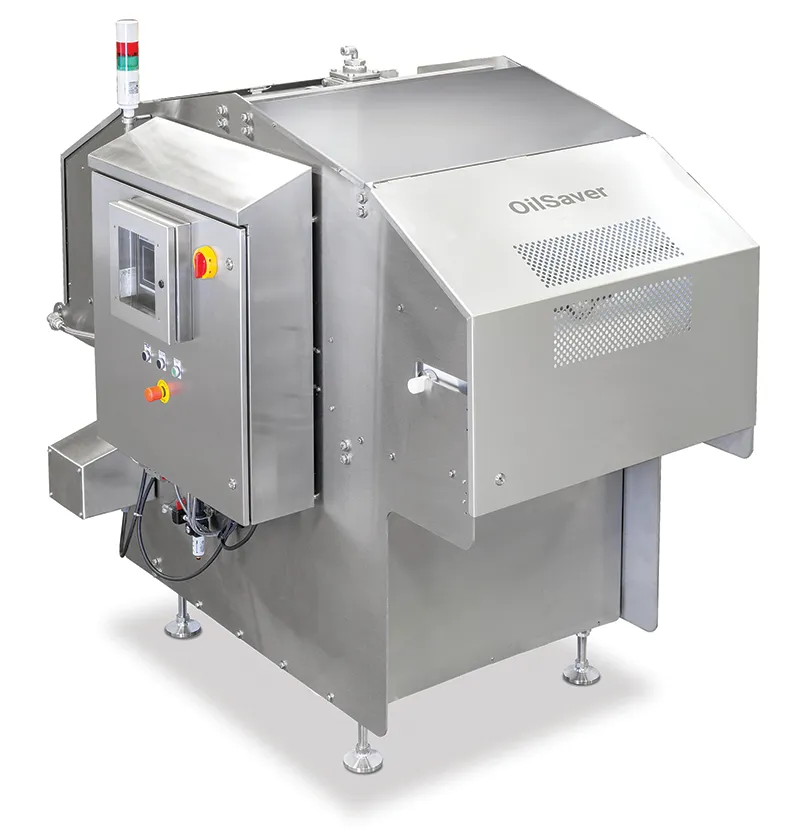
Clean oil, continuously.
The NIA Filters OilSaver connects to your industrial fryer (100+ gallons) and continuously pulls a slipstream of oil through a 1-micron filter media — then returns crystal-clean oil to the kettle.
Because filtration is continuous and automatic, oil never degrades to the point of needing replacement. Most solids and sediment are removed within 5 minutes of entering the oil, which means your fryer is cleaner when the sanitation shift starts — and cleaner oil is more energy-efficient oil.
Four steps. Zero oil changes.
Slipstream Draw
The OilSaver continuously draws a stream of hot oil from your fryer using safe vacuum technology — no pressurized hot-oil spray risk.
1-Micron Filtration
Solids, fines, spices, and flavorings are captured down to the 1-micron level — far beyond what belt or paper filters can catch.
Cake Drying Sequence
A drying cycle forces every last drop of cooking oil out of the sediment “cake” and back to the fryer — reclaiming up to 5–10 gallons per day.
Clean Oil Return
Polished, clean oil returns to the kettle. Color stays perfect from 6 a.m. to midnight, FFAs stay in check, and your oil life extends indefinitely.
Full system walkthrough — filtration, drying sequence, and clean oil return.
60-second look: sediment out, oil back in. Visit our YouTube channel to see it action.
What 1-micron filtration has been shown to do.
The ability to filter down to 1 micron is the primary reason the NIA Filter is so effective at keeping frying oil in good condition — continuously.

Consistent color, all day
Maintain the “perfect” fry color from 6 a.m. to midnight.
Slow FFA growth
Keep free fatty acid growth in line with oil turnover — even on products with higher oil pick-up.
Eliminate FFAs entirely
With low oil pick-up, an absorbent can be used to eliminate free fatty acids.
Remove spices & flavorings
Strip carry-over spices and flavorings out of the oil between products.
No smoking or off-flavors
Smoking, scorching, and off-flavors will never be an issue.
Fewer boil-outs
Reduce the frequency of cleaning and boil-outs — run production instead of sanitation.
Lower energy costs
Cleaner oil uses less energy to maintain heat.
Protect the heat exchanger
Stop fines from building up in the tubes — more energy-efficient, longer equipment life.
Switch to cheaper oil
Move to a less expensive, less stable oil — the NIA Filter keeps it in good condition.
The drying sequence: oil the belt filters leave behind.
Most conventional filters are continuous belt filters — the solids drip off the belt along with a fair amount of oil. The NIA Filters OilSaver drying sequence forces every last drop of cooking oil out of the sediment cake and back to your fryer.
|
Capability |
OilSaver by NIA Filters |
Conventional Belt Filters |
|---|---|---|
|
Filtration level |
1 micron |
Coarse — fines pass through |
|
Oil left in removed sediment |
Recovered via drying sequence |
Drips away with the solids |
|
Oil reclaimed vs. belt filter |
+20% by weight — often 5–10 gal/day |
— |
|
Oil changes required |
Never |
Ongoing schedule |
|
Hot-oil spray risk |
None — vacuum technology |
Present in pressurized systems |
|
Line downtime for oil changes |
Zero |
Recurring lost production |
Prove it on your line: weigh your solids/sediment during one full day of operation. Roughly 20% of that weight is oil the NIA Filters OilSaver can reclaim — on many lines, that’s 5–10 gallons of oil recovered per day.
Production time is expensive. Stop losing it to oil changes.
With oil quality always good, you never shut the line down to change oil — and fewer boil-outs mean more production hours and less spend on sanitary chemicals.